
Table of Contents
Some stainless steel sticks to magnets, while some doesn't. It all depends on what type you have. This matters when choosing materials for appliances, tools, or construction.
Whether a magnet sticks to stainless steel depends entirely on the steel's alloy composition and structure. Stainless steel is a broad category, and not all types exhibit magnetic properties.
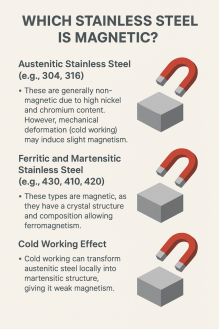
These are generally non-magnetic due to high nickel and chromium content. However, mechanical deformation (cold working) may induce slight magnetism.
These types are magnetic, as they have a crystal structure and composition allowing ferromagnetism.
Cold working can transform austenitic steel locally into martensitic structure, giving it weak magnetism.
Knowing whether a stainless steel is magnetic can influence material selection in various contexts:
Magnetic stainless steel is useful for attaching parts with magnets or for applications where magnetic sensors are involved.
Non-magnetic stainless steel is preferred where magnetic interference must be minimized.
Non-magnetic types prevent contamination from magnetic particles and simplify cleaning.
|
Question |
Answer |
|
Do magnets stick to stainless steel? |
Depends on the type; ferromagnetic types do, austenitic usually don't. |
|
Which types are magnetic? |
Ferritic (e.g., 430), Martensitic (e.g., 410/420) are magnetic. |
|
Which types are usually non-magnetic? |
Austenitic (e.g., 304, 316), unless cold worked. |
|
Does cold working change magnetism? |
Yes—can introduce weak magnetism in austenitic steel. |
Whether magnets stick to stainless steel hinges on its alloy class. Ferritic and martensitic variants are magnetic; austenitic variants generally are not—or only weakly magnetic if mechanically altered.
